When the European Union's ban on Russian and Belarusian wood products took effect in March 2022, it removed roughly 1.2 million cubic metres of plywood a year from the region's supply chains overnight. Four years on, that volume hasn't come back from a single source — buyers spread it across the Nordics, China, Turkey and, in smaller but growing volumes, South America. For Uruguayan and Argentine mills, the opening isn't in raw logs. It's in exactly the graded, finished products European buyers already know how to specify: clear boards and general appearance grade (APG) pine.
- 1.2 million m³ — annual volume of Russian plywood that disappeared from European supply chains after the March 2022 import ban, according to Timber Insider.
- 65,000 m³ — South American eucalyptus plywood (led by Brazil) shipped into the EU in 2023–2024 at €420–480/m³ ex-mill, per the same analysis.
- 7x — the price multiple sawn pine commands over raw logs out of Uruguay: $654/tonne versus roughly $93/tonne for unprocessed logs, per Wood Central.
- 7,000 m³/month — clear lumber output at Kluntex Lumber's Rivera, Uruguay plant, built specifically to supply the European market, per Uruguay XXI.
The Gap Russia Left Behind
The scale is easy to underestimate from outside the trade. When the EU's ban on Russian plywood took hold in March 2022, it erased about 1.2 million cubic metres a year from European supply chains in one move. Buyers didn't replace it from a single source: Chinese suppliers roughly doubled their EU plywood shipments between 2021 and 2023, from around 180,000 to 420,000 m³; Nordic mills in Finland and Sweden added an estimated 120,000 m³ a year; Turkish suppliers picked up close to 95,000 m³; and South American producers, led by Brazil, entered with 65,000 m³ of eucalyptus plywood in 2023–2024. The resulting price premium — 18–22% above pre-sanction baselines — has held through 2026 rather than fading as supply adjusted.
Why the Product Matters More Than the Origin
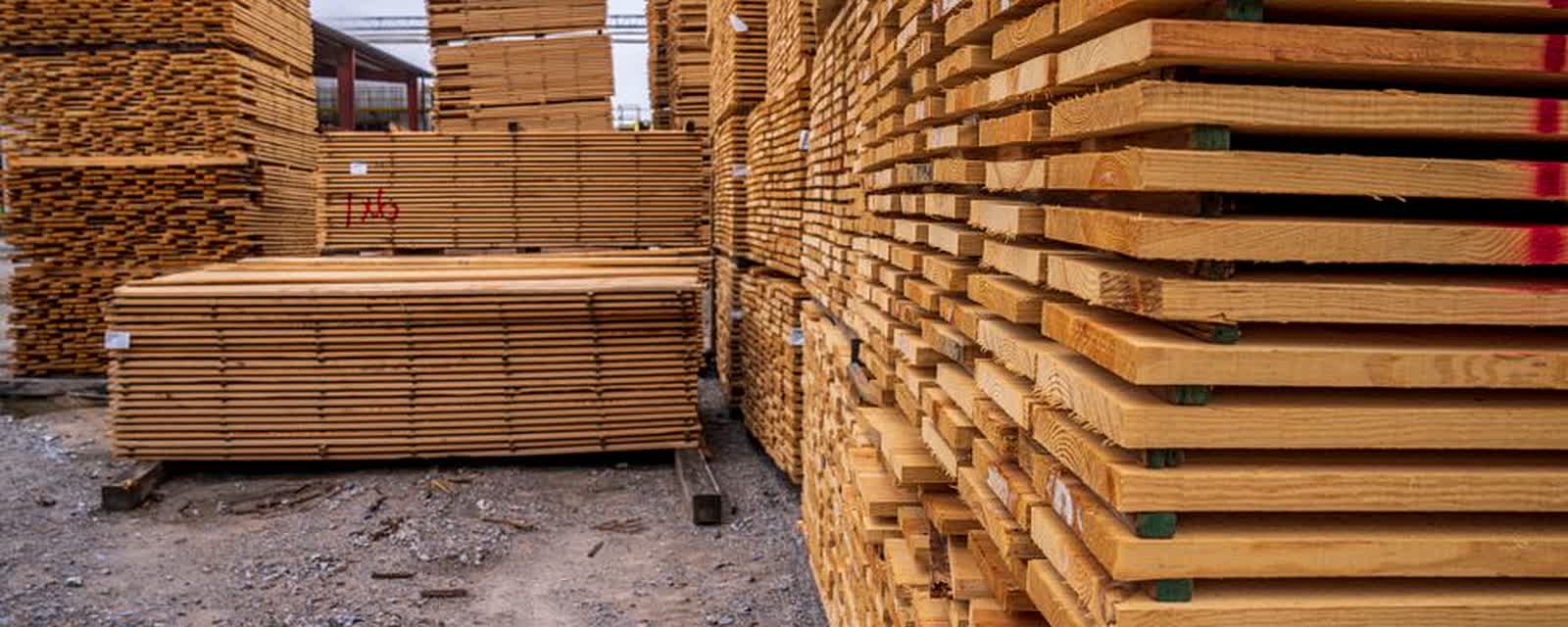
Raw logs don't solve this problem for European buyers, and they aren't where South American mills make their money either. Uruguay's own export figures make the case: sawn timber left the country at $654 a tonne in 2025, against roughly $93 a tonne for unprocessed logs — a sevenfold difference in value for material that has already been through a kiln and a grading line. That math is behind investments like Kluntex Lumber's US$8 million mill in Rivera, built to turn out 7,000 cubic metres a month of clear lumber aimed at European buyers, alongside furniture-grade stock for other markets. Clear boards and APG pine — kiln-dried, graded, ready to plane — are the products that compete on the same terms as the Nordic and Baltic material European buyers are used to specifying.
Certification Is the Filter
Price hasn't been the main obstacle for South American suppliers growing their European share — certified, documented volume has. Brazilian eucalyptus plywood landed in the EU at €420–480/m³ ex-mill in 2023–2024, competitive against Nordic birch on price, but supply stayed limited by certified capacity rather than by demand. For sawn timber specifically, the EU's deforestation regulation adds its own layer: due-diligence documentation is now a baseline requirement for wood traders moving product into the EU, with the compliance deadline already in force from 30 December 2026. Suppliers who can document chain of custody — and match it to a buyer's specific grading requirements — are positioned to take the next slice of the gap Russia left, not just the ones quoting the lowest price.
For buyers still paying the current premium on Baltic-grade appearance lumber, that combination — kiln-dried APG pine, documented origin, and the value-added grading Uruguay and Argentina are already producing for export — is worth pricing against a South American quote before the next contract cycle.