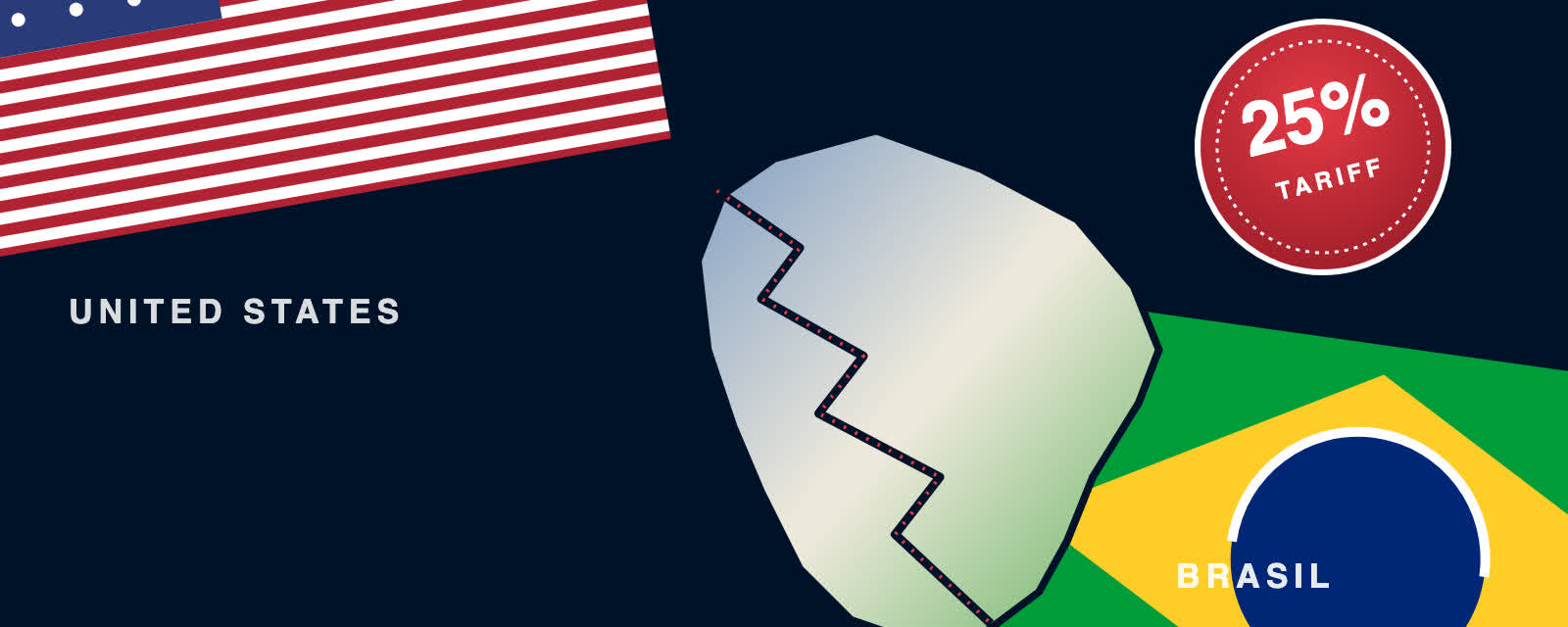
On 22 July 2026, a 25% US tariff on Brazilian goods took effect — the culmination of a Section 301 case that the Office of the United States Trade Representative (USTR) opened more than a year earlier. For South American timber suppliers watching from Argentina and Uruguay, the headline number matters less than the process behind it: this wasn't a snap decision, and understanding how it built up helps explain why Brazil's wood sector is reacting as sharply as it is — and where the opening for other South American suppliers is real.
- 25% — US Section 301 tariff on Brazilian goods, effective 22 July 2026 (USTR).
- 1 year — from USTR opening the investigation (15 July 2025) to the final tariff (15–16 July 2026).
- ~50% of Brazil's wood product exports (~US$1.2B in 2025) go to the US (ABIMCI, via ITTO).
- Illegal deforestation is one of the practices formally named in USTR's investigation.
A Year-Long Process, Not a Sudden Move
The tariff traces back to the broader "reciprocal tariff" regime the US applied globally starting in 2025, which already put Brazilian goods, including wood products, under added duties (ITTO Tropical Timber Market Report, 30:13). On top of that baseline, USTR opened a dedicated Section 301 investigation into Brazil on 15 July 2025, examining a specific list of Brazilian "acts, policies, and practices" — including digital trade and electronic payment rules, preferential tariffs, anti-corruption enforcement, intellectual property protection, ethanol market access, and illegal deforestation (USTR). Nearly a year later, on 1 June 2026, USTR determined that several of these practices were "actionable" and proposed tariffs on Brazilian goods. The final action followed on 15–16 July 2026: a 25% tariff, effective 22 July 2026 (USTR; Federal Register).
Illegal Deforestation Is Explicitly Part of the Case
One detail is easy to miss in the tariff headlines: illegal deforestation was one of the named practices under USTR's investigation from the outset, alongside the digital-trade and anti-corruption issues that got more press coverage (USTR). That detail matters for South American suppliers positioning around verified, traceable sourcing — the same due-diligence pressure driving EU regulation like EUDR is now visibly part of how the US frames trade decisions with Brazil, not just a European concern.
What the Tariff Covers — and Doesn't
The final measure carries an extensive exemption list — steel, aluminum, energy products, aircraft parts and certain wood products already covered by separate Section 232 measures are excluded — so its reach across timber HTS codes varies by product line rather than applying as a blanket 25% on every wood export. Even so, the US market is too large for Brazil's sector to absorb quietly. According to the Brazilian Association of Mechanically Processed Timber Industry (ABIMCI), the US has accounted for roughly 50% of Brazil's wood product exports, valued at around US$1.2 billion in 2025 (ITTO TTM Report 30:13). ABIMCI argued at a USTR public hearing in early July that Brazilian wood products come from planted forests, follow sustainable management practices, and complement rather than compete with US domestic production — the argument didn't change the outcome, and the association has since called the tariff a serious blow to competitiveness, warning it puts jobs, production levels and investment at risk (Argentina Forestal, 21 July 2026).
What This Means for Argentine and Uruguayan Suppliers
A meaningful cost disadvantage on Brazilian plywood, mouldings, doors, flooring and sawnwood in the US market changes the calculation for American buyers currently sourcing from a single country. It won't redirect volume automatically — qualifying a new supplier still takes documentation, sample orders and lead-time testing — but buyers actively re-evaluating their exposure to Brazil, and to the traceability risk that helped trigger this case, are a real audience. Suppliers based in Uruguay and Misiones province, Argentina, already operating with EUDR-aligned traceability, are positioned to answer that inquiry when it comes.