Uruguay closed 2025 with more forestry product moving out of its ports than ever before — and a smaller check to show for it. Export revenue fell 7% to US$2.786 billion even as shipped volume rose 5%, a gap explained almost entirely by softer cellulose prices. A few hundred kilometers north, a different number has been moving the other way: India's appetite for imported pine and eucalyptus, which is pulling volume from producers across the region and now shows up in real cargo movements out of ports on both sides of the Río de la Plata. For suppliers based in Misiones, Corrientes and Uruguay, the two trends point to the same question — with cellulose prices soft, where does the next buyer for softwood logs and sawn pine come from.
- US$2.786 billion — Uruguay's total 2025 forestry export revenue, down 7% year-over-year despite a 5% rise in exported volume (Uruguay XXI).
- 13% — drop in Uruguay's average cellulose export price in 2025, from US$610 to US$530 per ton, the main driver of the revenue decline (Uruguay XXI, via Argentina Forestal).
- US$2.3 billion / ~33 million m³ — size of India's annual forest-product import market, growing more than 7% a year (FAIMA, via Argentina Forestal).
- 20,000 tons — pine and eucalyptus logs loaded at the port of Concepción del Uruguay, Argentina, bound for Kandla, India, in August 2026 (Argentina Forestal).
A Record Year, With an Asterisk
Cellulose still dominates Uruguay's forestry export figures: US$2.317 billion in 2025, down 9% year-over-year, entirely on price — the volume shipped actually rose 5% to 4.4 million tons. Wood products, the category separate from pulp, told a different story: US$443 million, up 2%. Within that wood category, pine represents 65% of export value and 79% of volume, a reminder that even as cellulose sets the sector's headline number, pine sawnwood is the product line most directly exposed to buyer demand beyond the pulp mills — and the one that kept growing while cellulose prices fell. The sector overall employs 19,309 people across 4,135 companies, 97% of them micro or small businesses, working 1.16 million hectares of planted forest, 6.6% of Uruguay's territory (Uruguay XXI).
Where India Fits In
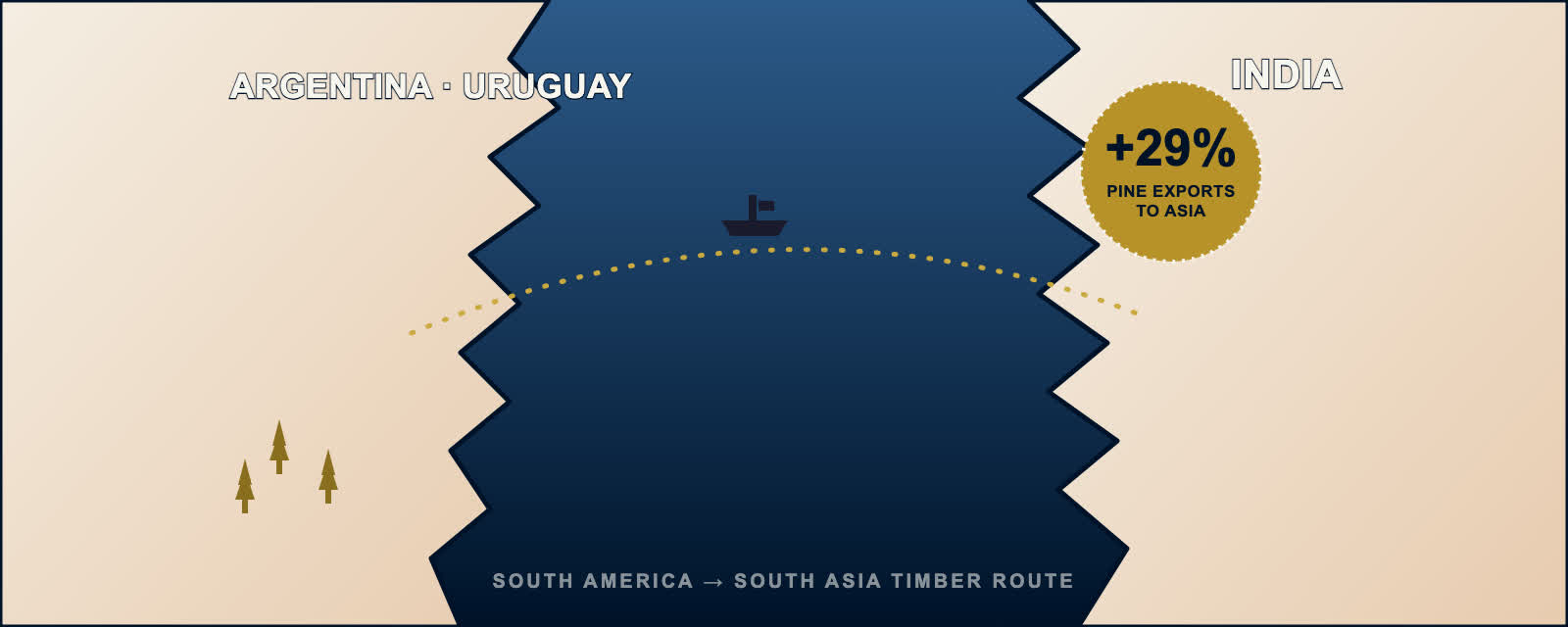
India imports roughly US$2.3 billion, or about 33 million cubic meters, of forest products a year, and industry representatives cite specifically unsatisfied demand for softwoods — pine and eucalyptus — used largely in pallet manufacturing, on top of broader growth above 7% annually tied to infrastructure investment (FAIMA report, via Argentina Forestal). That demand is landing at a moment when other South American producers have reasons to look past their usual markets: a property-sector slowdown has cooled demand in China, and trade friction — including tariff and antidumping measures affecting Brazilian wood products in the US and EU — has added pressure on the region's largest exporter. Argentine sawn pine exports to Asia grew 29% year-over-year in 2025, with wood-veneer exports up 229%, growth industry sources attribute in large part to buyers redirecting toward India.
A Cargo That Illustrates the Trend
In August 2026, the bulk carrier Beyond 2, sailing under a Marshall Islands flag and arriving from Côte d'Ivoire, loaded 20,000 tons of pine and eucalyptus roundwood at the port of Concepción del Uruguay — a river port in Entre Ríos province, Argentina, worth distinguishing from the country of Uruguay despite the shared name. The cargo, handled by exporter Urcel Argentina, was bound for Kandla on India's western coast. It followed an earlier 2026 shipment of roughly 18,000 tons of pine logs loaded at the nearby port of Ibicuy for the same route. Individually, each shipment is a single data point; together, they are the physical version of the import-growth figures India's own trade groups have been citing.
What It Means for Suppliers From Misiones, Corrientes and Uruguay
The signal across these numbers points the same direction: pallet-grade pine and eucalyptus, not pulp, is the product line where South American producers currently have the clearest opening in India, backed by unmet demand that industry sources describe directly. For suppliers already set up for EUDR and ISPM-15 compliance, the practical takeaway from Uruguay's 2025 figures isn't the overall revenue dip — it's that the products least tied to the cellulose market kept growing while pulp prices fell. That is a case for weighting commercial effort toward sawn pine and pallet components bound for markets like India, rather than toward destinations shaped by the same softening cellulose economics.
Sources
- Uruguay XXI — Informe Sector Forestal 2026
- Argentina Forestal — "Uruguay: la industria forestal exporta más de US$ 2.700 millones al año y emplea a casi 20.000 personas", 11 August 2026
- Argentina Forestal — "Cargan un buque de 20.000 toneladas de pino y eucalipto hacia la India en el Puerto de Concepción del Uruguay", 11 August 2026
- Argentina Forestal — "Mercado de USD 2.300 millones: aumenta la demanda de madera a India y se abre una nueva ventana a las exportaciones argentinas", 14 June 2026