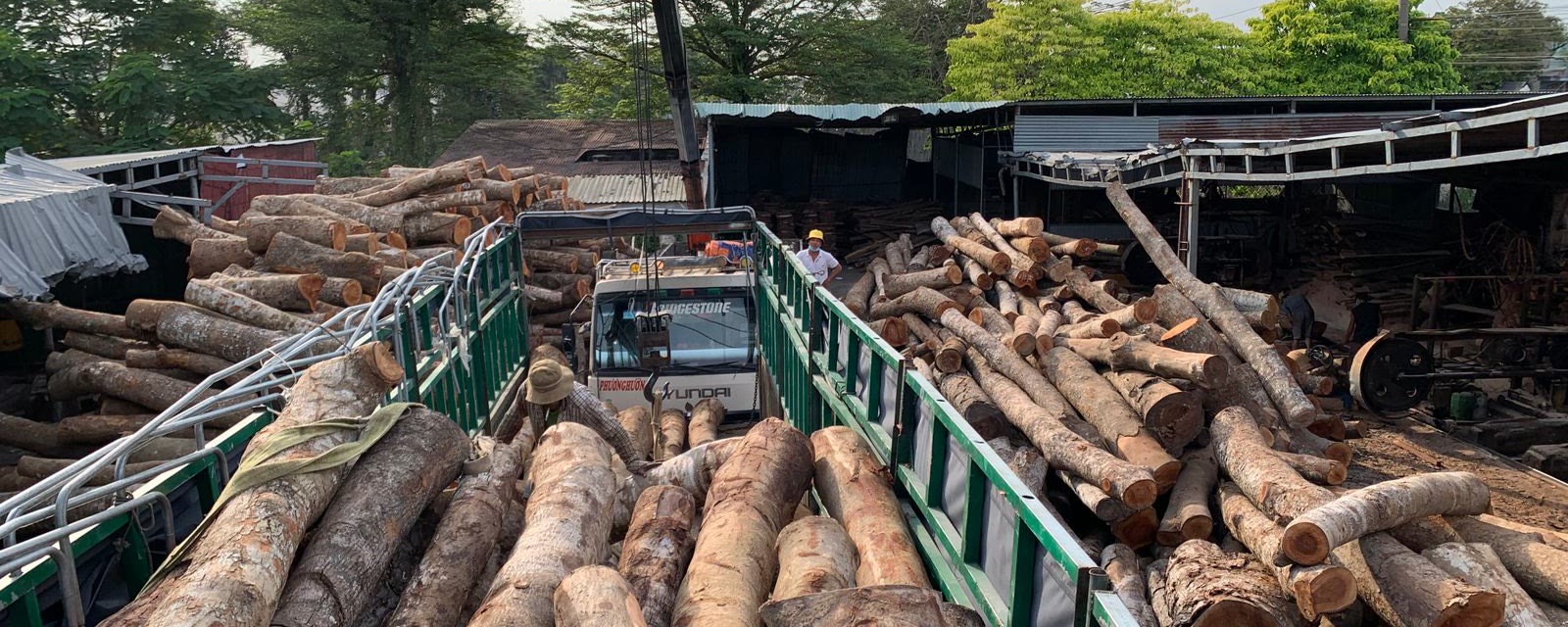
Two Southeast Asian markets rarely lead the conversation in South American timber trade, yet both are quietly rewriting where they buy their wood. The Philippines and Thailand spent decades drawing down their own forests — one through deforestation, the other through a hard legal ban — and both now lean on imported softwood to feed construction and furniture industries that keep growing. For pine producers in Argentina and Uruguay, the shape of it is familiar: it is the same structural shift that opened India, one market earlier in its curve.
- US$832M — Philippine forest-product imports in 2024, with China alone supplying 56% (US$439M), according to USDA FAS.
- ~466,000 m³ — Philippine lumber imports in 2023, up from ~344,000 m³ in 2022 (Orissa International).
- Chile 41% · Vietnam 30% · Argentina 25% — the sources of 96% of Thailand's pine-wood imports, Sept 2023–Aug 2024 (Volza).
- 1989 — the year Thailand banned logging in its natural forests, locking the industry into plantation wood and imports.
The Philippines ran down its own forests
The Philippines has roughly 7 million hectares of actual forest cover left, down about 40% from 12 million hectares in the 1960s, and only a fraction of that is closed forest dense enough for commercial harvest (USDA FAS Philippine Wood Products Report, December 2025). Domestic log production was around 582,000 m³ in 2023 and declining — roughly 71% of it a single fast-growing species, Falcata (USDA FAS; Orissa International). Against that shrinking base, demand keeps climbing. The construction industry, worth about US$60 billion in 2022, is projected by the World Bank to grow more than 7% a year through 2027; the "Build Better More" infrastructure program carries a US$162 billion pipeline; and a US$13 billion airport in Bulacan province began construction in January 2026 (USDA FAS). The furniture and wood sectors together generated US$1.54 billion in 2024 and are growing 20–25% a year (USDA FAS). US forest-product exports to the Philippines rose 33% in 2024 and were forecast to grow another 30% in 2025 — almost entirely softwood lumber (USDA FAS). The wider timber market is expected to expand at more than 4% a year through 2030 (Orissa International).
Thailand closed its forests in 1989 and never reopened them
Thailand imposed a nationwide ban on logging in natural forests in 1989, following catastrophic floods that were blamed on cleared hillsides, and has relied ever since on plantation rubberwood and eucalyptus plus imports (Orissa International). Its wood-and-furniture export machine — around EUR 10 billion in 2023, with sawn-timber exports alone near EUR 1.2 billion and forecast to grow 5.4% a year through 2029 — runs partly on imported raw material. As manufacturing costs rise in China, furniture production has migrated into Thailand, bringing with it "a growing need for imported softwoods" (Orissa International). Thai factories blend local teak and rubberwood with imported pine and spruce for the mid-priced furniture that makes up most of the export volume.
Both markets specifically want traceable softwood
Two things point the same way. The first is species: what the Philippines and Thailand are short of is coniferous wood — pine, spruce, fir — for framing, mouldings, plywood cores and furniture. That is exactly the gap the EU, Canada, New Zealand and the US are already filling in the Philippines (USDA FAS), and where Chile, Vietnam and Argentina already supply almost all of Thailand's pine (Volza). The second is legality. The Philippines requires an Authority to Import from its environment department plus phytosanitary clearance on every shipment (Orissa International); Thai exporters, selling on into the EU and US, face mounting pressure to prove their inputs are legal and traceable (Orissa International). Plantation pine from South America — grown on land with a documented land-use history, shipped with geolocation data to EUDR standard, phytosanitary certification and kiln-drying — answers that question cleanly.
Where South American pine fits
Thailand is already a working trade lane: Argentine and Chilean pine make up about two-thirds of its pine imports today, so the route, the specs and the customs process are established — the room is for more volume and steadier supply. The Philippines is closer to greenfield: no South American supplier shows up in its import tables yet, which is both the obstacle and the opening. Neither market flips overnight. Qualifying a new origin still takes sample orders, documentation and lead-time trials, and the freight distance from the River Plate to Manila or Laem Chabang is real. But the supply–demand gap in both countries is structural and widening faster than domestic forestry can close it — and global analysts already rank the Philippines among the fastest-growing pine import markets, with volume up more than 40% year on year (GTAIC). Structural gaps are what move sourcing decisions.
For a buyer in Manila or Bangkok weighing a first South American shipment, or a producer in Misiones or Uruguay with volume to place, the groundwork is worth starting now — before the lane gets crowded.
Sources
- USDA Foreign Agricultural Service — Philippine Wood Products Report (RP2025-0061), 23 December 2025
- Orissa International for the Ministry of Foreign Affairs of Estonia — "Opportunities in Thailand" (Timber), January 2025
- Orissa International for the Ministry of Foreign Affairs of Estonia — "Opportunities in the Philippines" (Timber), 2025
- Volza — Pine Sawn Timber / Pine Wood Imports in Thailand
- GTAIC — Global Pine Sawn Wood Trade 2025, 13 August 2025