Search "wood import requirements for India" and ISPM-15 comes up first, almost every time. It's the standard most guides lead with — and for a shipment of raw pine or eucalyptus logs, it's the wrong one to check. ISPM-15 covers something narrower than most people assume: the wood packaging used to move other cargo, not timber itself as cargo. The regulation that actually clears a log shipment through Indian customs is a separate, less-discussed order — and mixing the two up is a real way to lose time at port.
- 65% of India's total timber imports clear through Kandla port, roughly 3.5 million cubic meters a year (Indian Forester journal).
- 48 g/m³ for 24 hours at 21°C+ — the methyl bromide fumigation dose required for raw timber before export to India, endorsed on the Phytosanitary Certificate (Plant Quarantine Order, 2003).
- ISPM-15 covers wood packaging material — pallets, crates, dunnage — not raw logs, sawn timber, or engineered wood (IPPC).
- 12 km from Kandla port to Gandhidham, the sawmilling hub that processes most of that volume.
What ISPM-15 Actually Covers
ISPM-15 — the International Standard for Phytosanitary Measures No. 15 — is the IPPC standard adopted globally, India included, for regulating wood packaging material in international trade: pallets, crates, dunnage, and similar material thicker than 6mm used to move other goods. It requires heat treatment or fumigation and the HT/MB stamp buyers recognize on pallets worldwide. What it explicitly does not cover is raw logs, sawn timber, plywood, OSB, or other engineered wood moving as cargo in its own right.
What Actually Clears Raw Timber Into India
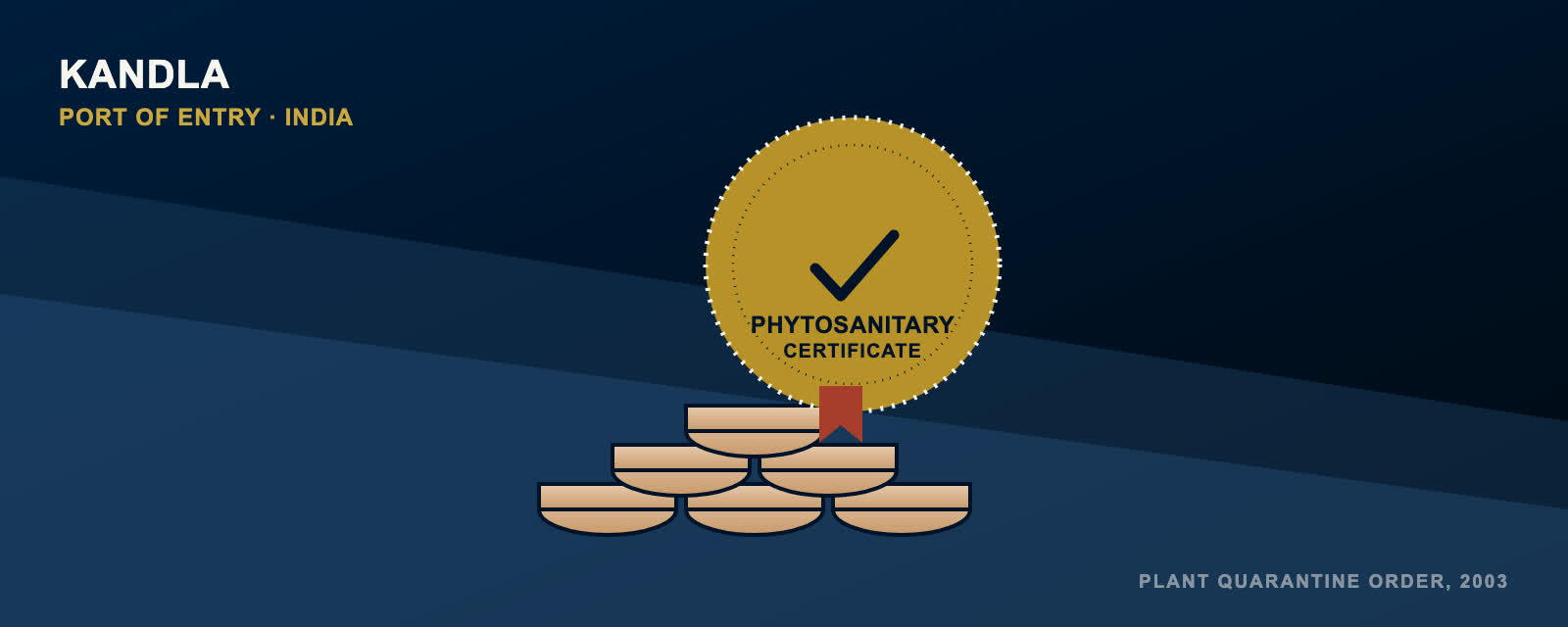
Raw timber and logs — with or without bark — fall instead under India's Plant Quarantine (Regulation of Import into India) Order, 2003. The operative requirement: fumigation prior to export with methyl bromide at 48 g/m³ for 24 hours at 21°C or above, or an equivalent treatment approved by India's Plant Protection Adviser, with that treatment endorsed directly on the Phytosanitary Certificate issued in the country of origin. Without that certificate and endorsement, a shipment doesn't clear — no matter how well it complies with ISPM-15.
Where It Lands — Kandla
In practice, most of that volume converges on one port. Kandla handles roughly 65% of India's total timber imports, around 3.5 million cubic meters a year, with pine, meranti and teak as the dominant species. Gandhidham, 12 kilometers from the port, functions as the processing hub for that volume — sawmills, plywood manufacturers and traders concentrated close enough to move logs straight from the dock.
What This Means for a Pallet-Components Shipment
Pallet components are Trading Globe's top product line into India, which means two separate compliance layers can apply depending on exactly what's on the vessel. Raw component blanks moving as timber cargo need the Plant Quarantine Order's fumigation and phytosanitary certificate to clear as logs. A finished, assembled pallet — built and stamped in India, or exported as a complete unit — is what actually falls under ISPM-15. Knowing which one applies before a shipment leaves the mill is what keeps it from sitting at Kandla.
Sources
- Government of India — Plant Quarantine (Regulation of Import into India) Order, 2003
- International Plant Protection Convention (IPPC) — ISPM 15, Regulation of Wood Packaging Material in International Trade
- Indian Forester — "Wood Import at Kandla Port of India and Identification of Alternative Indigenous/Plantation Species for Import Substitution"