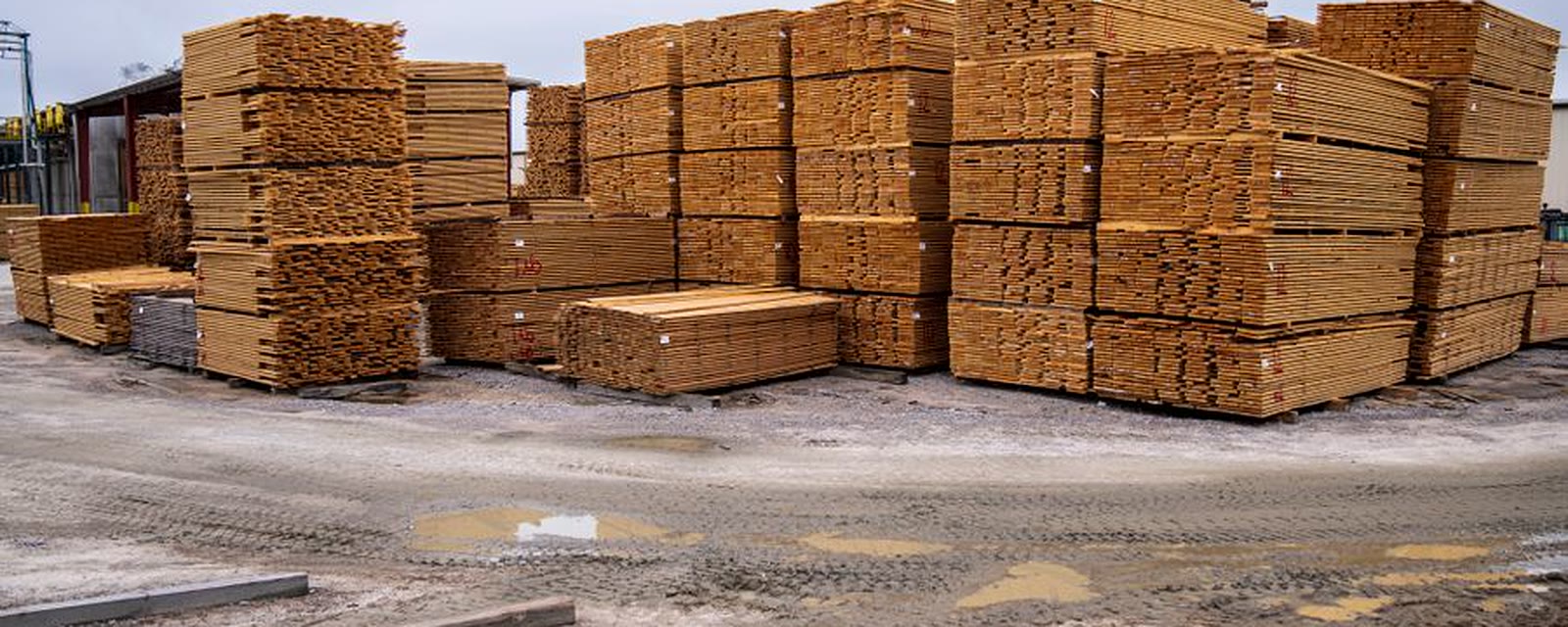
Vietnam is the single largest buyer of South American plantation pine, and the reason is structural: it bans logging in its own natural forests, runs one of the world's biggest furniture export industries, and has to import the difference. But what most producers on this side of the Pacific do not realise is that Vietnam sorts imported timber by where it comes from — and that Uruguay and Argentina were placed on opposite sides of that line.
- US$10.2 billion — Vietnam's wood and wood-product exports in the first seven months of 2026, up 5.6% year on year, with the United States taking 50% (Vietnam Customs / VIFOREST via Wood Central).
- 3–3.5 million m³ — the raw timber Vietnam imports every year to feed that industry, because logging in its natural forests is banned (Forest Trends).
- 51 countries — the "positive geographic regions" Vietnam's Ministry of Agriculture listed on 27 November 2020 under Decision 4832/QĐ-BNN-TCLN. Uruguay, Brazil, Chile, the US and New Zealand are on it. Argentina is not.
- 15 November 2024 — the date Decree 120/2024 took effect, replacing the three import forms of Decree 102/2020 with a single Form 01 (USDA FAS).
Why Vietnam has to import in the first place
Vietnam's wood industry is built almost entirely on imported and plantation raw material. According to Forest Trends' Timber Legality Risk Dashboard (drafted September 2024), the country bans the logging of natural forests — a ban it describes as "generally well-enforced" — and also bans the export of logs and sawnwood from those forests. Domestic plantations of acacia, rubberwood, eucalyptus and pine cover part of the gap, but 70–80% of that plantation volume is small-diameter wood that goes to chips, pellets and MDF, not to sawn timber. The rest is imported: between 3 and 3.5 million cubic metres of raw material a year, from sources that range from low-risk temperate suppliers to high-risk tropical ones.
The industry that consumes it is large and export-driven. Wood Central, citing Vietnam Customs data and the Vietnam Timber and Forest Products Association (VIFOREST), reported exports of US$10.2 billion in the seven months to July 2026, up 5.6% — with the US alone worth US$5.09 billion, or half the total, followed by China (US$1.535 billion) and Japan (US$1.267 billion). Furniture is still the core of that figure at US$6.4 billion, though it slipped 2.3% as US tariffs bit: since 14 October 2025 the US has applied a 10% tariff on softwood and 25% on furniture from Vietnam, according to Vietnam Briefing. Hanoi's target for the full year is US$19 billion.
VNTLAS: the rule that decides what an importer has to prove
Since 30 October 2020, every shipment of timber entering Vietnam has been subject to the Vietnam Timber Legality Assurance System (VNTLAS), enacted by Decree 102/2020/ND-CP as part of the country's FLEGT Voluntary Partnership Agreement with the European Union. The core mechanism is risk classification of the origin. The Ministry of Agriculture and Rural Development (MARD) publishes a list of "positive geographic regions" — countries whose timber is treated as lower-risk — and a list of species already imported into Vietnam that are considered of no concern. Anything not on either list is, by default, high-risk.
What that means in practice is spelled out by the Japan Wood-Products Export Association's guide to Decree 102/2020. For non-risk species from a positive region, the importer files the declaration of origin and "no additional documentation is required." For timber from a non-positive region or a risk species, the importer must add evidence of legal harvest — either a certificate or national scheme "recognized by Vietnam as meeting VNTLAS standards," or a "license or document proving permission to harvest timber" — plus a description of risk-mitigation measures and the export rules of the harvesting country.
Decree 120/2024, issued on 30 September 2024 and in force since 15 November 2024, tightened the system further. USDA's Foreign Agricultural Service, which published an unofficial translation (GAIN report VM2024-0036), highlights three changes: confiscated timber is no longer considered legal; the three import forms of the 2020 decree were replaced by a single Form 01; and the positive-region and species lists must now be updated and republished annually, before 31 December, on MARD's website and at kiemlam.org.vn.
Uruguay is on the list. Argentina is not.
The published list that gave the system teeth is Decision 4832/QĐ-BNN-TCLN of 27 November 2020. Its Annex II names 51 positive geographic regions across five continents. Among them, in the Americas group, are Brazil, Chile, the United States — and, as item 50, "Cộng hòa Đông U-ru-goay," the Eastern Republic of Uruguay. Argentina does not appear. Annex I, the catalogue of species already imported, does include the three that matter to this trade: Pinus elliottii, Pinus taeda and Eucalyptus grandis.
The practical consequence is asymmetric. A Vietnamese buyer receiving kiln-dried Pinus taeda from a Uruguayan mill files Form 01 and clears. The same species, same grade and same moisture content from Misiones or Corrientes puts the buyer into the supplementary-documentation track: harvest permits or an equivalent legality certificate, a risk assessment, and a note on Argentina's export rules. None of that is impossible — Argentine plantation pine is legally harvested and provincially documented — but the paperwork sits with the importer, and importers price friction.
Two caveats. First, the list is now updated annually under Decree 120/2024, and the current edition is published in Vietnamese on MARD's site; the 2020 decision is the version that is publicly documented in English, so any Argentine shipment should be checked against the latest annex before contracting. Second, Forest Trends notes that Vietnam treats imports of temperate species as low risk with the exception of Russian timber — so an Argentine pine shipment is unlikely to be flagged as a species risk, only as an origin-documentation matter.
The trade is growing anyway
None of this has stopped South American pine from moving. Argentina's Ministry of Economy, citing INDEC statistics, reported on 29 April 2026 that forestry exports to Vietnam grew 33% in the first quarter of 2026 against the same period of 2025 — behind India (+350%) and the US (+56%), ahead of China (+9%) — with sawnwood sales up 30% in volume, after the sector closed 2025 up 18% and selling to more than 70 markets. On the other bank of the river, Uruguay's Dirección General Forestal (MGAP) reports that Vietnam takes 10% of Uruguayan sawnwood exports, the third destination after the United States (27%) and China (18%).
What this means for buyers and sellers
For a Vietnamese importer, the lesson is to price the origin, not just the species. Uruguayan pine and eucalyptus arrive with the lightest documentary load VNTLAS allows; Argentine pine arrives with an equally legal but heavier file that the importer — not the exporter — is responsible for at customs. For an Argentine mill, the lesson is that a Vietnamese buyer who asks for harvest authorisations, transport guides and a written risk assessment is not being difficult: they are filling in Sections B2 to D of Form 01. Having that dossier ready before the first inquiry is what turns a "non-positive" origin into a routine shipment.
Trading Globe sources from both banks. Uruguayan volume clears on the short track; for Argentine pine from Misiones and Corrientes, we assemble the harvest-legality and traceability file — the same chain-of-custody evidence EUDR now demands for Europe — so the Vietnamese importer receives Form 01 with its supplementary documents already attached, not a request to go and find them. See our Vietnam market page for KD/S4S specifications and port routing.
Sources
- Wood Central — "Vietnam Wood Exports Reach $10.2bn but Slide in the US," 23 August 2026 (citing Vietnam Customs and VIFOREST)
- Wood Central — "Vietnam's Wood Export Growth Now Comes from Chips, Not Furniture," 3 August 2026
- Forest Trends — Timber Legality Risk Dashboard: Vietnam (drafted September 2024)
- USDA Foreign Agricultural Service — "Vietnam Issues Decree Revising and Amending Regulation of Timber Legality Assurance System" (GAIN VM2024-0036), 22 October 2024
- Ministry of Agriculture and Rural Development of Vietnam — Decision 4832/QĐ-BNN-TCLN, 27 November 2020 (Annex I: imported species; Annex II: positive geographic regions)
- Japan Wood-Products Export Association — Vietnam: standards and regulations for timber imports (Decree 102/2020 documentation by risk level)
- Argentina.gob.ar (Secretaría de Agricultura, Ganadería y Pesca) — "Foresto industria argentina: más de 70 mercados y un crecimiento sostenido del 18%," 29 April 2026 (INDEC data)
- El Observador — "Los números del Uruguay forestal," 10 June 2025 (Boletín Estadístico, Dirección General Forestal, MGAP)
- Vietnam Briefing — "Navigating Vietnam's Wood Industry in 2026," updated 16 March 2026