Every shipment of pine or eucalyptus that Trading Globe coordinates from Argentina, Uruguay or southern Brazil travels with a document set that depends on the product, the origin and the destination country. This page explains each requirement in plain terms and separates what Trading Globe and its sawmill partners provide from what the importer must verify on their side. It is a commercial reference, not legal advice: destination rules change, and the importer's customs broker and national plant-protection authority are the final word.
1. EUDR — EU Deforestation Regulation (EU) 2023/1115
What it is. EUDR prohibits placing on the EU market wood and wood products linked to deforestation or forest degradation after 31 December 2020, or produced in breach of the laws of the country of origin. The EU operator — the importer — must file a due diligence statement before the goods enter the EU.
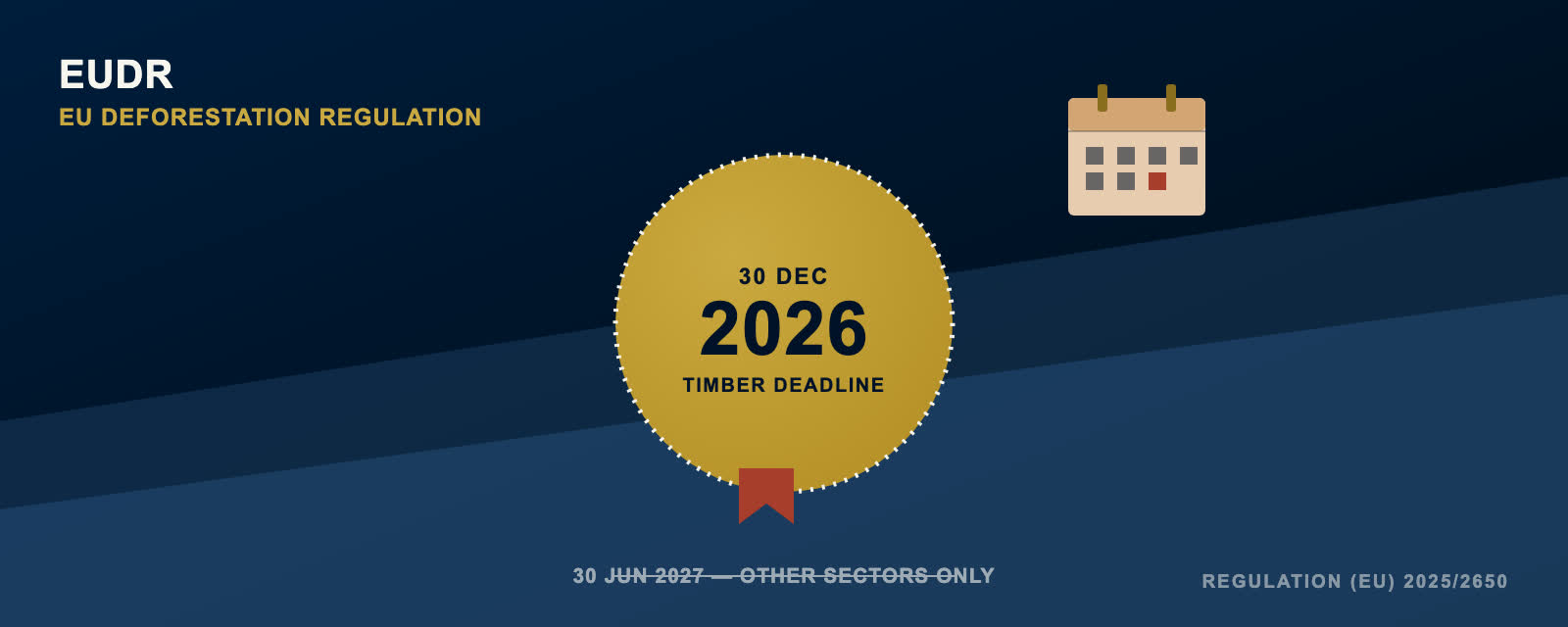
- 30 December 2026 — compliance date for all timber operators and traders, including micro and small ones, after the second postponement (Regulation (EU) 2025/2650).
- 30 June 2027 — the later date for micro and small operators applies to other product categories, not timber, because wood was already covered by the EU Timber Regulation (995/2010) since 2013.
- 31 December 2029 — wood harvested before 29 June 2023 may still be sold under the old rules until this date.
What Trading Globe provides. Geolocation of the forest plots supplying each order (polygon or point coordinates, as the regulation requires), the harvest period, the legal-origin documentation of the sawmill partner, and a chain-of-custody record from sawmill to port — the information the EU operator needs to complete its due diligence statement.
What the importer must verify. Registration in the EU Information System, submission of the due diligence statement with its reference number on the customs declaration, its own risk assessment and mitigation, and record-keeping for five years. Source: European Commission; see Timber Doesn't Get EUDR's 2027 Grace Period.
2. Phytosanitary certificate
What it is. An official certificate issued by the national plant protection organisation of the exporting country — SENASA in Argentina, the Dirección General de Servicios Agrícolas (MGAP) in Uruguay — attesting that the consignment meets the phytosanitary import requirements of the destination, including any treatment the destination demands.
Destination-specific example — India. Raw timber and logs entering India fall under the Plant Quarantine (Regulation of Import into India) Order, 2003: fumigation with methyl bromide at 48 g/m³ for 24 hours at 21 °C or above (or an equivalent treatment approved by India's Plant Protection Adviser), endorsed on the phytosanitary certificate issued at origin. ISPM-15 does not replace this requirement. See ISPM-15 Isn't the Rule That Gets Your Timber Into India.
What Trading Globe provides. Coordination of the required treatment and of the certificate application at origin, with the treatment endorsed on the certificate when the destination requires it.
What the importer must verify. The current import requirements of its national plant-protection authority for the specific product (logs, sawn timber, panels), species and origin, before the order is confirmed.
3. ISPM-15 — wood packaging material
What it is. The IPPC standard for wood packaging material used to move other cargo — pallets, crates and dunnage thicker than 6 mm. It requires heat treatment (HT) or fumigation and the ISPM-15 mark applied by a registered producer. It does not cover logs, sawn timber, plywood, OSB or other wood moving as cargo in its own right.
How it applies to Trading Globe products. Pallet components (pre-cut boards and blocks) are supplied with heat treatment when the buyer requires it; the ISPM-15 mark itself is applied to the finished packaging by the registered manufacturer in the destination country, under its plant-protection authority.
What the importer must verify. Whether the finished pallet will be marked locally (the usual case) or must arrive treated and marked from origin, and what its authority requires in each case.
4. Kiln drying (KD)
What it is. Drying of sawn timber in a kiln to a controlled moisture content, which gives dimensional stability and is required or expected by many construction, furniture and packaging buyers.
What Trading Globe provides. Kiln-dried pine and eucalyptus with a kiln-drying certificate issued by the sawmill stating the drying process and target moisture content. Moisture content is agreed per order to the buyer's specification. Air-dried (AD) eucalyptus is available for buyers who dry locally.
What the importer must verify. The moisture content its application and grading rules require, and whether a KD certificate from the mill is sufficient or a third-party inspection is required.
5. Standard export document set
For a typical container or break-bulk shipment Trading Globe coordinates:
- Commercial invoice
- Packing list with dimensions, pieces and volume
- Bill of lading
- Certificate of origin
- Phytosanitary certificate, with treatment endorsement where required
- Fumigation or heat-treatment certificate when the destination or buyer requires it
- Kiln-drying certificate from the mill
- For the EU: the geolocation and legal-origin data described under EUDR
Species, grade, dimensions and moisture content are stated on the invoice and packing list as agreed in the order.
6. Summary — who does what
| Requirement | Trading Globe and sawmill partners provide | The importer verifies / does |
|---|---|---|
| EUDR | Plot geolocation, harvest period, legal-origin documents, chain of custody | Due diligence statement in the EU Information System, risk assessment, 5-year records |
| Phytosanitary | Treatment at origin and certificate from SENASA / MGAP-DGSA with endorsement | Current import requirements of its plant-protection authority |
| ISPM-15 | Heat-treated pallet components on request | Local marking of finished packaging, authority rules |
| Kiln drying | KD certificate from the mill, moisture content per order | Required moisture content, inspection needs |
| Customs documents | Invoice, packing list, B/L, certificate of origin | Import licence, duties, local customs broker |